Types of heat exchangers
A heat exchanger is as useful as it is adaptable, so it’s essential to seek professional technical advice when choosing the one that best suits your intended use, as it will contribute to increasing the efficiency of your installation.
Depending on the type of fluid contact
- Direct. In a direct heat exchanger, the fluids mix, so they can become contaminated due to the mixing of one fluid in poor condition with the other. Cooling towers are the prototypical example, since they spray the water to be cooled onto a set of plates (called the exchanger filling), while an air flow in the opposite direction or perpendicular to the drops circulates through the plates, causing a minimum part of the water to evaporate, which produces a cooling of the remaining water and, therefore, a heat exchange. Finally, the now cold water falls into a tank.
- Indirect. Fluids can flow in three directions (as we’ll see below), but what distinguishes this type of heat exchanger is that it prevents the fluids from mixing, since they are separated by a tube wall or another element (such as plate or tube heat exchangers). In these, heat exchange occurs in three phases: convection, conduction, and then convection again.
- Convection: The hot fluid transfers its heat to the inner wall of the tube or plate.
- Conduction: This occurs through the tube or plate itself.
- Convection: In this case, heat is transferred from the outside of the tube or plate to the lower-temperature fluid.
According to the direction of the fluids
- Parallel. The hot fluid, which circulates through the inner tube, and the cold fluid, which circulates through the outer tube, flow in the same direction and in the same direction.
- Counterflow. The fluids move in the same direction, but in opposite directions, so they enter the exchanger at opposite ends. This type of exchanger is more efficient than the parallel flow type, as it achieves a higher outlet temperature for the cold fluid and a lower outlet temperature for the hot fluid.
- Crossflow. The fluids travel through the exchanger perpendicular to each other, but they do not touch, since one passes through the tube and the other surrounds it. Its application is most common when one of the circulating fluids changes phase within the device. Within this type, the following distinction is made: “mixed type,” when one of the fluids circulates without restrictions, and “non-mixed type,” when plates are installed to determine the flow direction.
- Combined. Some heat exchangers allow one of the fluids to circulate either in parallel or countercurrent. For example, in a tubular heat exchanger where the hot fluid flows through the shell, the cold fluid could pass through the interior of the exchanger twice, once in each direction, to maximize heat transfer.
According to the number of times heat is exchanged
- Single pass. Heat is exchanged only once. Sometimes, multiple heat exchangers are installed in series to increase process efficiency or simply because a single pass doesn’t achieve the target temperature.
- Multiple passes. There is more than one exchange point. These usually feature mixed flow, since arranging the tubes in a “U” shape is much more convenient, taking up less space and increasing heat transfer.
According to the structure
Concentric tubes. Double-tube (or concentric tube) heat exchangers have the simplest structure, as they consist of one tube inside another (they are concentric). The fluids can flow through them in counterflow or in parallel. In addition, some tubes have fins to ensure that the contact area on the outside of the tube is greater than on the inside. This is essential for cases where the heat transfer coefficient of one of the fluids is much greater than that of the other. When the flow is cross, the fins are arranged transversely to the axis of the tube, while if it is parallel or crossed, they will be placed longitudinally with respect to the axis.
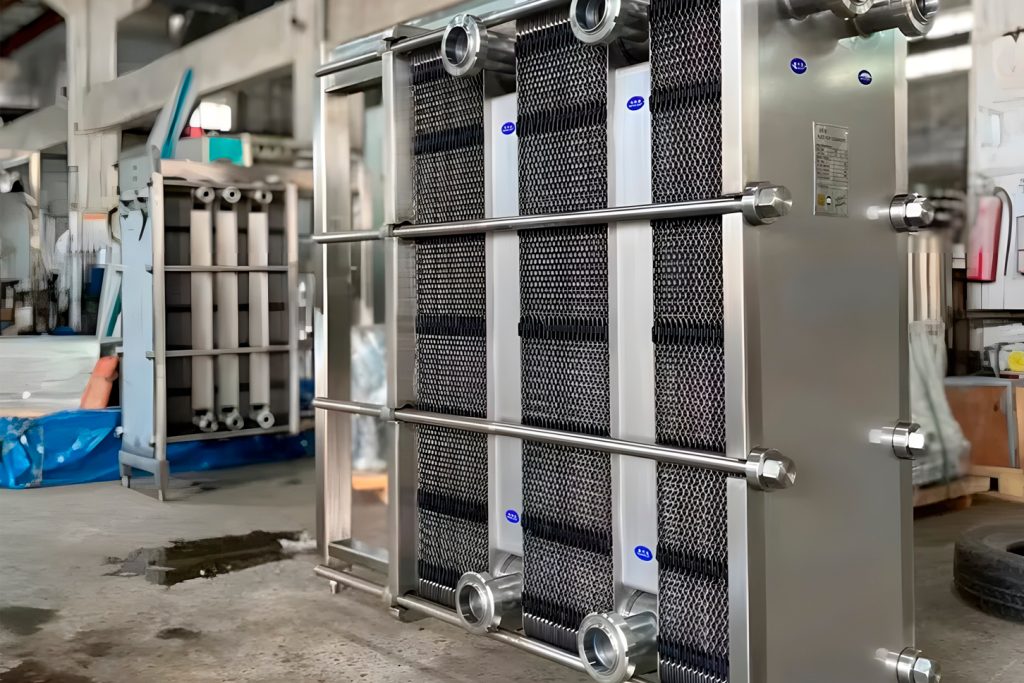
Plates. A plate heat exchanger consists of a series of corrugated metal sheets arranged in parallel and secured to a steel casing, separated by gaskets. These grooves create turbulent flows in the fluid, even at low flow rates. A different fluid should circulate on each side of the plate, either in parallel or countercurrent, but some manufacturers recommend counterflow to avoid thermal stresses in specific areas. Plate heat exchangers can be “compact,” designed to facilitate a larger heat transfer area; and “regenerative,” a type characterized by the passage of a cold fluid that removes the heat accumulated in the solids before reaching thermal equilibrium. This is achieved by changing the flow rates. Plate heat exchangers can be installed when NH3, CO2, or glycols are used as refrigerants.
Shell and tube bundle. Also known as a shell and tube heat exchanger or tubular heat exchanger, it is very common in industry and typically goes hand in hand with NH3-oil systems, for example. It is called a tube bundle because it consists of a large capsule (shell) containing a variable number of tubes, which are positioned in their corresponding locations thanks to a perforated baffle plate. This, however, has another function: to cause a turbulent, cross-flow of the fluid through the shell to improve convection. If the fluids have very different pressures, the one with the higher pressure will flow through the tubes, while the one with the lower pressure will travel through the shell. The reason behind this arrangement is that the tubes can withstand higher pressures. The tubes can be arranged in squares (easier to clean and with a lower pressure drop on the shell side), in a rotated square (same benefits), or in triangles (greater contact surface, but more complicated to clean). Furthermore, they can be either single-pass or multi-pass, depending on the specific needs of the installation. Evaporators (whether horizontal or vertical tubes) are, in fact, tubular heat exchangers, since they have a heating chamber and an evaporation chamber divided by the surface area of the tubes where the heat exchange takes place.
Air-cooled. This system is similar to a cooling tower, as it consists of finned tubes through which the fluid circulates, and fans, which force (or induce) the air to flow along these tubes to cool it.
Source: Cofrico.com